Tag: Trends

  • Ikea Between Sustainability And Investigations

    Ikea Between Sustainability And Investigations

    IKEA continues its commitment to the defense of minorities against social issues: after the communication campaign  against gender inequality and domestic violence in 2018, in February 2019 launched one against cyberbullying and May as against discrimination against the LGBT community

    Read also There is no room for gender inequality in Ikea

    His commitment was rewarded at Cannes with a Lion grand prix Health & Wellbeing (health and wellness) thanks to product innovation created by Mccann Tel Aviv aimed at improving the social impact of Ikea products making them accessible to people with disabilities

    The ‘This Ables’ campaign was carried out with the cooperation of several NGOs specialized in designing solutions for people with physical disabilities

    All the campaigns mentioned so far are so-called cause-related marketing initiatives, that is advertising that supports social causes, and that represent the values ​​of the brand (and suggest how the brand wants to be seen by its consumers)

    Initiatives that also aim to correct the perception of the brand  modified by some news that created a backlash like that of the single mother of two children – one of whom is 100% disabled – fired by the company (the judge’s sentence then confirmed the provision ) or the accusations of age discrimination in some stores in the United States [1]

    Not only social in the Swedish giant brand communication: in order to align with the goals of sustainable  development in the 2030 Agenda, Ikea developed with DDB Group Italy ” minds of change: we support the idea of changing ” an advertising campaign which promotes the initiative of those Italians who propose to improve the environment in response to the ecological emergency. In this perspective, Ikea has announced that starting from 2020 it will distribute only recycled plastic products or products made from renewable materials in its stores and that by 2030 it will reduce the impact of each marketed product by 70%.

    Ikea is active in  promoting responsible consumption styles and a stronger environmental awareness , as well as making us reflect and take a stand on controversial and debated issues of high social value, always connecting with the theme of the home. It is no coincidence that Ikea has embraced a strategy called ” People & Planet Positive “, for which sustainability and social activism take the form of projects and actions that allow more and more people to have a better, healthier and future-oriented daily life. Planet, explains a press release issued on the occasion of the 30th anniversary in Italy .
     “The ambition to improve the daily life of the majority of people has guided us in these first 30 years in Italy. We are proud to continue to do so every day together with our 7,500 employees and over 40 million customers who have chosen us only in the last year  – says again in the statement Assunta Enrile, Country Retail Manager and Country Sustainability Manager of Ikea Italia -.We look at the present and the future with optimism, thinking about how to continue to be close to the people and the challenges they are facing, in social and environmental terms, remaining faithful to the idea of ​​democratic design. Ikea, in fact, will continue to be at the forefront of these issues, because we are convinced that change also comes from small daily gestures and that design can help us live better in our homes, in society and on the planet that is our common home “.

    Ikea has shown in recent years to be attentive to ecology, investing in product innovation, in particular on one of the ‘main’ raw materials of its furniture: wood. Ikea has been committed since 2016 to obtain 100% of wood from ecological sources [2] and works with environmental associations (such as the WWF) to develop a more sustainable market for wood and cotton [3]

    The ecological policy is also applied to address the problem of pollution generated by indoor toxic substances, because it is at home that we are exposed to 95% of pollutants, according to a study by the National Renewable Energy Protection Association. The Swedish giant says it does not use flame retardant chemical solutions normally used in furniture (to have a certain level of fire resistance) to the benefit of more sustainable solutions such as wool [4]

    And it is always with this in mind that in 2019, together with a team of engineers, designers and specialists, universities in Europe and Asia, Ikea designed the curtains that purify the air : GUNRID , made in a fabric that ‘dissolves’ common pollutants indoor air, such as formaldehyde. This fabric consists of a mineral-based photocatalytic coating that is applied to the fabric. If activated by light, both internal and external, GUNRID breaks the common indoor air pollutants. The GUNRID air purification tent will be available in IKEA stores in 2020. It is one of the first IKEA products to deal with indoor air pollution, but probably not the last.


    The importance of ethical communication

    If it is essential that the multinationals today promote dialogue on important issues such as bullying, gender inequality, homophobia, it is equally fundamental that they do not do it to deflect attention from their potentially harmful  or bad practices, what in jargon is called ‘attention deflection’. It is a current topic, at a time when many citizens are worried about their future, and companies communicate their ‘green’ and social commitment like never before

    Read about this ‘ Communication for Good 2019 Italy trends

    Surely the adv campaigns created by Ikea in the world have the ability to make sustainability exciting, encourage users  to move from intention to action, are new because they challenge the status quo, are Nurturing as they focus on the needs of Others, and inclusive  and Respectful of all humans, they avoid discrimination

    Despite their efforts of innovation and communication , for greater environmental sustainability and a maximum responsibility towards its consumers , to which Ikea would like to facilitate everyday life, the Swedish company risks a fine   such as that assigned to FCA and Starbucks . By the end of the year, in fact, the European Commission, which has been investigating since 2017 on Inter IKEA Systems, will have to communicate its position regarding a 2016 report presented by the Greens in the European Parliament.

    According to  Reuters reports , the authorities would like to repress tax agreements granted to Inter Ikea Systems, from the Netherlands

    Inter IKEA Systems is the owner of the intellectual property of the Ikea brand and concept,  Inter IKEA System is part of Inter IKEA Holding based in Luxembourg, which belongs to a company in the Netherlands Antilles

    Inter IKEA Systems commented by e-mail to Reuters that ” like all other companies that work under the IKEA brand, Inter IKEA Systems BV undertakes to pay taxes in accordance with laws and regulations, wherever it operates. We believe that even in these cases we have paid the correct amount of taxes ”.

    In fact, as Forbes also points out, the practices that derive from the corporate establishment of entities that hold the intellectual property of a trademark are not illicit and indeed allow the company to save taxes and customers to enjoy quality products at affordable prices.

    According to the Greens’ report, this’ saving ‘would amount to one billion euros

    The information is also reported in the online company database D&B Hoovers [5] , which considers several branches of the company that could be used for tax avoidance purposes at high risk.

    independently of the decision of the European Commission, Ikea’s commitment could be extended to allow all interested parties to discover the company’s decisions : what are the benefits that European consumers will derive from the decision to create a complex corporate system as far as legal that yes, as Forbes affirms, allows the abatement of prices on the shelf, but creates a loss to the treasury for each country that goes from 35% less collected in Belgium to 64% of France?

    Allowing the consumer to have all the information to help him make an conscious purchase decision is an act of responsibility that every company that decides to embrace the ‘Communication for Good ‘ should do, so that sustainability could be a genuine, integrated practice ( not bolted on)

    Also read: the communication for good manifesto 


    SOURCES

    https://www.reuters.com/article/us-eu-ikea-ab-taxavoidance-exclusive/exclusive-ikea-to-face-eu-order-to-pay-dutch-back-taxes-sources-idUSKBN1WM0PP

    https://www.startmag.it/economia/ecco-perche-la-commissione-ue-seghera-ikea-sulle-tasse-light-in-olanda/

    http://www.affaritaliani.it/green/ikea-ecco-la-campagna-sostenibile-al-fianco-di-chi-propone-idee-verdi-618130.html

    http://www.affaritaliani.it/economia/ikea-fisco271114.html?refresh_ce

    http://www.affaritaliani.it/milano/ikea-giudice-mamma-licenziata-per-fatti-disciplinari-571629.html

    https://ilmanifesto.it/il-giudice-corretto-il-licenziamento-della-mamma-di-ikea/

    http://www.vita.it/it/article/2014/11/25/sono-non-profit-per-motivi-fiscali-parola-di-ikea/128549/

    https://adage.com/article/special-report-cannes-lions/ikeas-thisables-wins-cannes-lions-grand-prix-health-and-wellness/2178341

    https://www.siks.it/ikea-contro-cyberbullismo-campagne-social/

    https://www.ninjamarketing.it/2019/05/17/ikea-lancia-la-campagna-fateloacasavostra-giornata-contro-omofobia/

    https://www.greenstyle.it/ikea-sleep-pride-30-anni-tra-relax-coscienza-ambientale-rispetto-e-inclusione-308330.html

    https://ikea.today/meet-gunrid-air-purifying-curtain/


    [1] a report on the Business and Human Rights website entitled “USA: the employee filed a lawsuit against Ikea for alleged age discrimination; incl. company statement “and dated February 2019, stated:” Ikea was hit with its fifth lawsuit in just over a year in US courts, claiming age discrimination. ”

    [2] The IKEA Sustainability Report 2016 stated: “All the wood used in IKEA products comes in accordance with the IKEA IWAY standard Forestry Section. In Exercise 18 we expanded the IWAY forestry section to include paper-based materials, bamboo in non-industrial applications, rattan and wood-plastic composites. For more information on IWAY, see pages 46-47. Furthermore, we aim to obtain 100% of the wood we use from more sustainable sources: Forest Stewardship Council ™ (FSC ™) or recycled. In financial year 18 we obtained 85% of our wood from these sources, from 77% in fiscal 17 “.

    [3] On the WWF website, on a page called “WWF and IKEA Transforming Business for People and Planet”, it was declared: “WWF and IKEA are working together to safeguard and manage valuable natural resources and transform the business for the benefit of people and the planet. Through commitment, innovation and defense, the partnership is driving the development of more sustainable cotton and timber markets. ”

    [4] on the IKEA website in the “IKEA Frequently Asked Questions” area it is specified “The IKEA approach to chemicals is to add them only if necessary. IKEA undertakes to refrain completely from the use of chemical flame retardants in our products and instead use techniques and materials with flame retardant properties, eg. lanaAll brominated flame retardants were gradually eliminated from IKEA furniture production in 2000. ”

    [5] D&B Hoovers was founded by Gary Hoover and Patrick Spain in 1990 as an American research company that provides information on companies and industries through their main product platform called “Hoover’s”. Today its database contains information on over 300 million companies with 30,000 global data sources updated 5 million times a day

    Author: elena grinta

    I have been dealing with communication for 20 years, I have worked in marketing for large international and Italian companies and I know the mechanisms of advertising persuasion. I decided to invest my know-how and my skills to use the available resources of companies (budgets but also human capital) in positive transformation. Because to students from all over the world I teach at Purpose Brands in Catholic University I wish to give more and more examples of virtuous companies that have invested for the future, of everyone (and there are already many!). Because if we watch, without acting, without taking responsibility, we have no excuse.

  • Welcome To The H2H Era! Danone as a Bcorp

    Welcome To The H2H Era! Danone as a Bcorp

    Danone, the French food giant, has decided to undergo the BCorp certification, which is a real challange, considering that  Danone is listed on the stock exchange  and that failure to achieve this goal could have negative repercussions on the company, adding only “paperwork and unnecessary restrictions” [1] . Instead, the CEO Emmanuel Faber has announced to want to reach the necessary parameters to the certification and to become a B Corp within 2030 , after that also Danone North America – the eighth branch of Danone (and the largest) – has become a B Corporation certified. Danone North America is Danone’s 8th subsidiary to become a Certified B Corporation. Some critics say that filing as a B adds unnecessary paperwork and restrictions. But for brands looking to connect with growing consumers, B Corp’s status establishes integrity and builds consumer goodwill.

    A danger that is worth running, Faber said, because ” certification has received great support from employees and has won over skeptical investors” [2], as well as having instilled confidence in the banks, which they renegotiated at a lower loan of two billion euros [3] .

    Emmanuel Faber fully embodies the role of the corporate activist , when he declares that he wants to be a promoter of a “Food Revolution”[4] and urges the industry to join a “movement” that aims to “the adoption of healthier products and of sustainable eating habits “[5] .

    ” Food sovereignty  for us means giving up control and restoring power to people, and how credible would we be to tell our consumers if we didn’t start with our employees?”[6] , Faber asks.

    To be credible as a ‘brand activist’, all stakeholders, starting with employees, should embody the values ​​of the company and its ideology. “The purpose can become marginal if you don’t work at it. Therefore, it is essential to give people the responsibility to make the brand responsible for its goals and philosophy. “[7]

    The new era of ‘people powered brands’ is no longer just a consumer at the center program, but a paradigmatic transformation from Business-to-Consumer to Human-to-Human (from B2C to H2H).

    Here’s how the ‘legal person’ can become a ‘natural person’: through the hundreds of faces, personalities, dreams that constitute the ‘workforce’ of every business reality. Bryan Kramer, who first used the expression H2H, says  Businesses do not have emotion. People do. People want to be part of something bigger than themselves. People want to feel something. People want to be included  [8] It is not just a ‘social media’ strategy [9] where it is sufficient to show the team behind the product and the magic is done. No. All human resources must be involved and treated as Resources, and Humans. One of the biggest mistakes you can make is investing huge budgets in campaigns to activate your customers and not invest effectively in internal communication, making little effort to tell your story and your progress within the company. Showing the social impact that the company is having can be highly effective when it is measurable and closely linked to the company’s operations.

    We hope that Danone, once he has obtained the B Lab certification, will promote a 360 ° sustainable revolution, setting the pace for the other players, perhaps starting from the plastic issue. Perhaps then they will think twice about launching “innovative products” like Eletrolytes Evian for millennials [10] or Mickey Mouse water for children . The oceans will be thankful.

    [1] https://www.forbes.com/sites/simonmainwaring/2018/09/28/business-building-lessons-from-the-largest-b-corp-in-the-world/#70e5f19379f4

    [2]  https://it.businessinsider.com/b-corp-un-new-model-of-capitalism-good-for-state-that-create-value-for- all-the-societa-only-only -for-the-shareholders /

    [3] https://www.reuters.com/companies/DANO.D

    [4] https://www.just-food.com/interview/how-danones-manifesto-is-shaping-its-corporate-activity-just-food-interview-part-two_id137131.aspx

    [5] https://www.marketingweek.com/danone-repositioning-manifesto-brand/

    [6] The whole concept behind food sovereignty is for us to surrender control and give the power back to people, and how credible would it be to say to our consumers if we don’t start with our employees? “

    [7] https://www.marketingweek.com/danone-repositioning-manifesto-brand/

    [8] https://bryankramer.com/there-is-no-more-b2b-or-b2c-its-human-to-human-h2h/

    [9] The Value of Getting Personal on Social Media

    [10] We re-ignited our evian brands in the US through the innovative #Iwanna campaign featuring Maria Sharapova, Madison Keys, Luka Sabbat and many inspiring micro-influencers across the country. Engagement was 20 times higher than traditional campaigns, reaching over 18 million consumers.

    Author: elena grinta

    I have been dealing with communication for 20 years, I have worked in marketing for large international and Italian companies and I know the mechanisms of advertising persuasion. I decided to invest my know-how and my skills to use the available resources of companies (budgets but also human capital) in positive transformation. Because to students from all over the world I teach at Purpose Brands in Catholic University I wish to give more and more examples of virtuous companies that have invested for the future, of everyone (and there are already many!). Because if we watch, without acting, without taking responsibility, we have no excuse.

  • Gender Inequality. Storytelling through images

    Gender Inequality Storytelling Through Images and the Role of Brands

    Stefano Stranges is a photographer from Turin who was born in 1978. In 2012, he attended the master class of the Magnum agency focused on reportage photography with particular interest in social projects.
    In one of his exhibitions called “Le bambine salvate,” Stranges was able to help raise awareness of the gender inequality problem in India by showing the lives of Indian girls. Some of the problems he shed light on included violence against women, forced marriages, rape, and general discrimination. Stranges has visited the villages where most of them come from and portrayed intimate, dramatic, and unexpectedly joyful moments.

    “My projects and my work start with the social and sociological approach and are determined by the empathy between my subject and me.”

    His photos are not posed. On the contrary, he portrays the typical day of an Indian girl at her house. In all of them you see young teenagers taking care of two or three children in their homes while their husbands are not around. They all share the same dream: to become successful independent working women.

    If a fourth child is a female, a popular superstition regards it as a sign of misfortune: Indhumati, born after a male and two females, would have been sacrificed if Terre des Hommes had not intervened. She today is 19 years old and studies computer science. She wants to become a teacher and devote herself to the children of less well-off families. She is very proud of her personal story. “The infamy of killing little girls must never be repeated,” she says.

    Karthiga, an 18-year-old girl and child of four, had another destiny: she got married with the boy next door and for this she had to interrupt her studies. Her day is divided between the child, the domestic tasks, and the calf to be cared for, all under the supervision of her mother-in-law.

    Harini, last of three sisters, lives with her parents in two rooms without windows built on the back of her father’s barber shop. Her passion for the studio transformed the house walls into sheets for notes. She studied civil engineering and dreamed of becoming governor of the Salem District. “God blessed us when he changed our mind and did not allow us to kill her as soon as she was born,” says her mother, who works for Terre des Hommes today.

    This dream for an Indian girl is very challenging to obtain; and for Stranges, it was not an easy task to describe.

    Two of my students from Università Cattolica had the opportunity to see “Le bambine salvate” exhibition on the field trip study during my course. One is from Germany, the other from Ecuador: two completely different countries and realities. Coming from diverse backgrounds made them perceive the exhibition in different ways and awakened different feelings.

    Constanze (German) said, “For me it was sad to see how gender inequality is still so strong and inclement in some corners of the world that it can even get to the point to kill little girls just to avoid paying for their education and life. However, when I saw the picture of the founder and director of Terre des Hommes Core, I felt a glimpse of hope for the Indian women. I knew that just the fact that one organization was already stepping up for women and their cause is already a good sign and way of getting to a better world. Coming from Germany where there are many independent and successful working women, it is really shocking to see these. I remember I was walking one day into a kindergarten to pick up one of my nieces and was surprised of the important number of fathers picking up the kids. I thought I was going to see more mothers, but this was not the case. I think people from India deserve to achieve this equity standard that Germany enjoys nowadays. In Germany women and men are almost equal. There are a lot of women who are responsible for their own works, families, and houses, just as men in India.”

    Isabel replied “For me, coming from Ecuador, the images of Stranges were realities I see everyday when walking around my city. The exhibition reminded me of the town where I go to the beach. Once, on a Saturday morning, I went to a bakery and there were only women working in the neighborhood. I found this weird and then I heard they were all complaining about how lazy their husbands were. I think gender inequality in Ecuador is different than in India, but it is still present. In this small-town, men take advantage of women in every way. They go out to party and get very drunk. As a consequence the following day they cannot work, and their wives must take care of their houses, children, the mess from last night, and even their work responsibilities. They think they are the rulers and because of this their wives must do all they asked them to. This is very wrong, because responsibilities should be divided equally. It should be as in Germany, where both women and men work, clean, and pick up children from school. A place where men also do laundry and go grocery shopping.”

    After discussing our different points of views, students mentioned the United Colors of Benetton campaign called #Unitedbyhalf that is committed to fighting gender inequality around the world, especially in Indian. It is a gender equality campaign that shows the many capabilities of Indian women and how they are the other half of the country. This means that not only the half of the country made up by men is able to achieve wonderful things, but women, the other half, are also capable of achieving highly.

    They also mentioned Ariel’s #sharetheload campaign about men sharing the laundry load with women. These two big brands are notable examples of gender equality promotions. Also, they incentive oppressed women to fight for themselves and their rights and give hope of a better and more equal world.

    While listening to their discussion, I thought both Ariel and Benetton are examples of ‘Purposewashing.’ I do prefer brands like Patagonia against Benetton because of its purpose (and I’m not alone), which is not just a matter of cause related marketing: Patagonia really does believe in what it does, because the company was born with it in its DNA. But at the same time I think we need to distinguish marketing/communication strategies and business strategies/processes.

    I have then shared with all my students this question: Considering communication as a persuasive tool, what should brands do? Should they try more efficient ways to sell their products (even with AI, etc.) or could they also create debate on social issues (eg. Dove, Ariel, etc.)? In other words, should brands create more meaningful ads (like Persil “Free the Kids”) even while they still have horrible impacts on the environment (with plastic waste, water consumption, etc.)?

    Le Bambine salvate Exhibition 2nd-8th  March 2019|  Fabbrica del Vapore

    Author: elena grinta

    I have been dealing with communication for 20 years, I have worked in marketing for large international and Italian companies and I know the mechanisms of advertising persuasion. I decided to invest my know-how and my skills to use the available resources of companies (budgets but also human capital) in positive transformation. Because to students from all over the world I teach at Purpose Brands in Catholic University I wish to give more and more examples of virtuous companies that have invested for the future, of everyone (and there are already many!). Because if we watch, without acting, without taking responsibility, we have no excuse.

  • The Supermarket is Green! Ecor NaturaSí

    The Supermarket is Green! EcorNaturaSí

    The EcorNaturaSì Group distributes organic and biodynamic products in specialized stores and supermarkets in Italy. The brand holds a strong position in the national market for its ethical products and its many activities in support of organic agriculture and culture in general. Compared to other supermarket brands in the European region, NaturaSì does not see sustainability and responsibility for production and consumption as a marketing strategy tailored to the corporate vision. Rather, the brand has integrated its commitment to organic production into all its operations, offering healthy and quality products that promote human well-being. The company’s history is rooted in promoting the development of a healthy and balanced biodynamic agriculture and seems to incorporate these practices into everything it does.

    The ideas of the renewal of agriculture, social life, and the science of nutrition are borrowed from Rudolf Steiner, who inspired the founders of Ecor, some of whom today preside over the Free Anthroposophical Foundation Rudolf Steiner, the majority shareholder of EcorNaturaSì.

    Ecor has from the beginning supported its producers and shopkeepers, also through loan or gift logics (very close to the Steinerian ideology) [i] and applying the ‘right price’, that is a price that ‘responsibly’ takes into account the production costs, the value of a decent job, the externalities caused and that generates a margin that can be reinvested in research and in socially useful works.

    The right price is opposed to the deceptively low price – as well explained by Raj Patel in his ‘The Value of Things’, a price that seems low (such as we spend $4 for a burger at a fast food chain), but actually corresponds to 50 times as much. If we consider the state subsidies paid to farmers of maize used to feed the cattle that are raised on deforested land (often illicitly), the state aid paid to the employees (often precarious) who work in restaurants with insufficient minimum wages or even spending on healthcare to treat diseases related to eating disorders, we find that today we are paying $200 for a hamburger that costs $4 for fast food. It is not a simple sophism.

    Read also: From a trade mark to a change mark

    According to a study carried out by the London consultancy firm Europe Economics, the listing fees (quota of access to the shelf) that producers pay to distributors to be present in the sign amount to a figure between 30 and 40 billion euros are equal to half of the subsidies that the European Commission guarantees to EU farmers through the common agricultural policy (CAP). To be more explicit, the taxpayers’ money spent in the CAP only serves to innovate (perhaps in the direction of a lower ecological impact) and in part to support the production costs that the large-scale retail trade negotiates to ensure a turnover growth. The choice to cut internal labour costs contributes to this same goal, forcing employees and suppliers to sometimes extreme precarious conditions. In the collective imagination, the exploiters of the tomato fields are the “corporals” and the criminal organizations that organize these activities. On closer inspection, responsibility should be shared among all those who generate these mechanisms.

    In this market struggle, the promise of the ‘right price’ [ii] maintained for Ecor brand products is likely to be engulfed by two factors, one endogenous (the choice to market non-exclusive products) and the other exogenous (the perception of the ‘right’ in an arena today more competitive than ever). Let’s go in order: Is the promise of the right price sustainable for the range of products that can be found in NaturaSì stores, as well as in the GDO? This doubt is linked to a crucial choice factor for the consumer, relating to the formation of the final price of the products on the shelf: how long can the claim for a higher price remain legitimate, when other competitors propose a portfolio of organic and sustainable references at more affordable prices? Without consumer education, it will be difficult (potentially impossible) to counter the persuasive force of retailers who loudly proclaim their sustainability and face the scandals that have cracked consumer confidence in the entire organic supply chain.

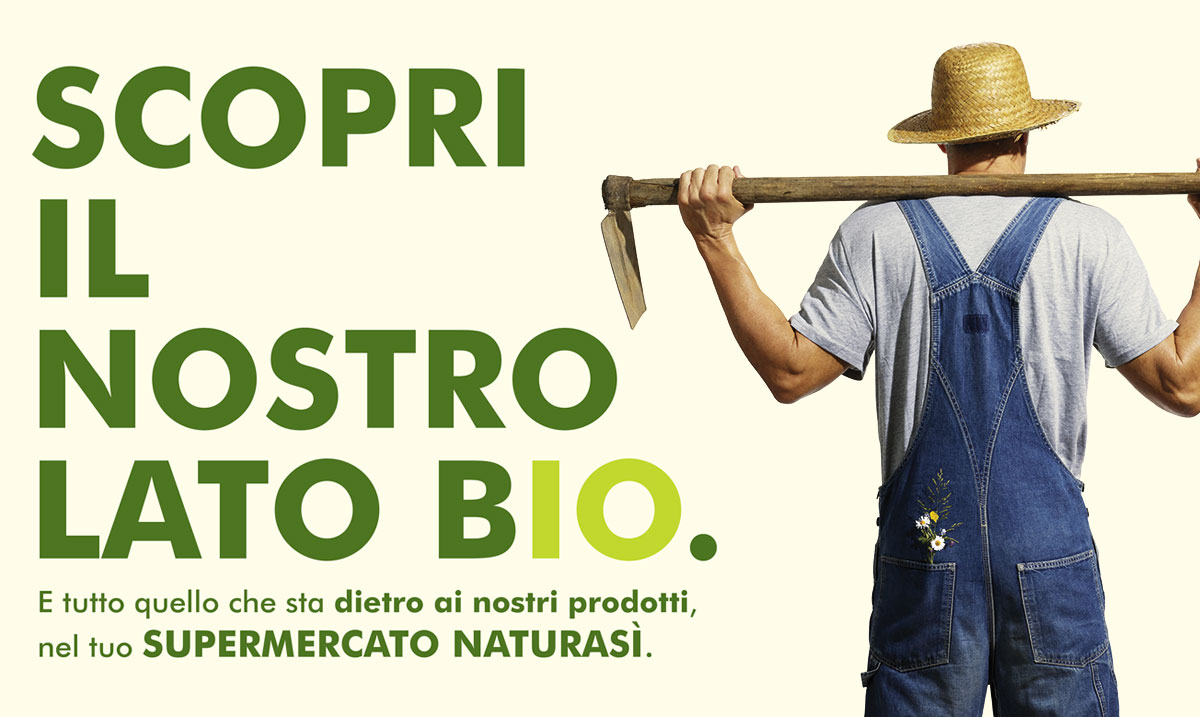
    Recently Natursì has re-planned a campaign carried out in 2017 by the Milanese communication agency Rifattimale by Manfredi Marino and Ugo Berretta. A farmer from behind shows his B (Biodynamic) side and the payoff reads: “DISCOVER OUR B-IO SIDE.” A play on words to attract the attention of consumers and encourage them to adopt a more conscious lifestyle. Roberto Zanoni explains, General Manager of the brand: “Buying food at our supermarkets means recognizing the right price to farmers, facilitating the growth of organic and biodynamic agriculture that protects the land and its fertility. Here, paying a few cents more for the products makes sense. The consumer must understand and be aware of the fact that the purchase choice goes beyond his own portfolio, it is a real responsibility for us and for our children” [iii].

    EcorNaturaSì enjoys an enormous competitive advantage and is now perceived as a leader in the ‘bio’ sector, but it is difficult to think that the attitude of consumers alone will change. To succeed in its purpose, Ecor should involve its competitors in the retail industry and turn them into accomplices by sharing knowledge and experience and guiding the transformation through the more widespread introduction on the market of biodynamic products made available to consumers of all income levels (and not only those who currently attend the Natursì stores). Ecor could incentivize the distribution of biodynamic products, guaranteeing potential growth for all producers thanks to the expansion of the network.

    To accelerate the change, it is the responsibility of companies with a utopian mission (and EcorNaturSì is fully committed) to conduct ‘battles’ at the sector level to create sustainable environmental practices through their own value leadership (and not just the market).

     [i] See, for example, the Adopt a Zolla23 project which invites (as a loan of money) parts of land on biodynamic farms.

    [ii] The promise “The products we distribute must contribute to improving human health, as well as the well-being of the soil and the environment in which we live.”

    [iii] “We want all consumers to be aware and make choices guided by awareness to protect human health, the environment and agriculture” explains Roberto Zanoni , General Manager of the brand. “NaturaSì has been committed for 30 years to supporting organic agriculture and farmers, for human and environmental health: buying food at our supermarkets means recognising the right price to farmers, facilitating the growth of organic agriculture and biodynamics that protect the Earth and it’s fertility. Here, paying a few cents more for the products makes sense. The consumer must understand and must be aware of the fact that the purchase choice goes beyond one’s wallet, it is a real responsibility for us and for our children because if we keep the land alive and fertile, here we can collect food that nourishes us and that does us good over time. This is our bio side: a commitment that we have put in place since the first day and that guides us even more today “.

    Since you’re here…
    Our mission is to monitor Advertising to make certain that companies obey ethical standards of trustworthiness and transparency while communicating their commitment to addressing the great challenges of the New Millennium. From climate emergency to social inequality through all the issues included in the Sustainable Development Goals Agenda, we monitor the consistency of their statements, if they are ‘walking the talk’. With rising misinformation and commercial ownership, independent information is more and more rare. We think citizens deserve access to accurate analyses with integrity at their heart, so we can all make critical decisions about our lives, health and enviroment – based on fact, not fiction.
    Our editorial independence means our content agenda is set only to voice our opinions, supported by in-depth research, free from any political and commercial bias, never influenced by interested owners or shareholders (which we don’t have). It means we can stand up to mainstream and give a voice to those less heard. We hope this will motivate you to make a contribution in support of our open, independent journalism. Every reader contribution, however big or small, is so valuable. Support BeIntelligent from as little as €5 – and it only takes a minute. Thank you.

    Support BeIntellgent

    Author: elena grinta

    I have been dealing with communication for 20 years, I have worked in marketing for large international and Italian companies and I know the mechanisms of advertising persuasion. I decided to invest my know-how and my skills to use the available resources of companies (budgets but also human capital) in positive transformation. Because to students from all over the world I teach at Purpose Brands in Catholic University I wish to give more and more examples of virtuous companies that have invested for the future, of everyone (and there are already many!). Because if we watch, without acting, without taking responsibility, we have no excuse.

  • Purposeful Communication: Opportunity or treat?

    One of the most important key components of a brand’s success is communication. Most of the times, even though sustainable and ethical practices are in place in a company, they fail to communicate their responsibility. And while it’s great that companies don’t act in a “good way” just for publicity, it’s also important to involve the community around them and let them know of everything they are putting into practice. Building a strong communication channel not only gives brands the chance to put out there their sustainable actions, but also gives them the opportunity to create a stronger bond with community, which feels taken into account when its informed about “internal” brand policies and practices. Is there a connection between the rise of interest towards branded content and the creation of more & more purpose driven campaigns?
    What’s the line between the brand and its purpose?
    Glass box brands should bring solutions to issues they bring to light

    Purposeful Communication: Opportunity or Threat?

    One of the most important key components of a brand’s success is communication. Most of the time, even if sustainable and ethical practices are in place, companies fail to communicate their responsibility. And while it’s great that companies don’t act in a “good way” just for publicity, it’s also important to involve the community around them and let them know about everything they are putting into practice. Building a strong communication channel not only gives brands the chance to release their sustainable actions, but it also gives them the opportunity to create a stronger bond with community members, who then feel heard because they are informed about “internal” brand policies and practices.

    Is There a Connection Between the Rise of Interest Towards Branded Content and the Creation of More and More Purpose-driven Campaigns?

    I was asked to write a paper for the BCMA book celebrating 10 years of the association’s activity, so I started reviewing the Grand Prix winners of the BC&E category at Cannes Lions ever since its inception:

    Winner of the 2012 Grand Prix was US-based Mexican restaurant chain, Chipotle for its “Cultivate” campaign; Intel and Pereira & O’Dell won for the “The Beauty Inside” in 2013, (No Grand Prix awarded on 2014 and 2015). In 2016 “The Displaced” for New York Timer VR, by Vrse; 2017 was “Beyond Money” by Santander and this year, KPN’s Evert_45 campaigns were awarded the Entertainment Grand Prix.

    In all of these examples, brands put their environmental and/or social commitment at the center of their marketing strategy. They transformed their own “brand structure” into a “purpose” to build a deeper connection with consumers.

    Surely, storytelling and purposing have a lot to share, but there is a potential downside for brands linking themselves to important social issues using storytelling to persuade their consumers.


    Look at what happened to Chipotle. The company always claimed to be “the healthy alternative to fast food.” Chipotle’s problem started back in July in Washington state, when 5 people got sick with E. coli after eating Chipotle, but it only made news on the local paper. Chipotle became a national story when bad tomatoes in Minnesota stores infected 81 people with salmonella in August. About the same time in California,  Chipotle told the local health department that 17 employees were sick with norovirus, a nasty intestinal bug: 230 people caught the virus. At this point, the problem, though serious, appeared to be isolated, and Chipotle’s executives thought they had it under control. That changed when a separate E. coli outbreak crossed state lines in late October. The company closed all 43 restaurants in 2 States. In total about 500 people got sick from eating Chipotle in the second half of 2015.

    What’s the Line Between the Brand and Its Purpose?

    “With an increasing number of businesses making it a focus of their marketing, consumers are understandably getting a little skeptical – particularly when there is not a clear line between the brand and its purpose.” -Charlotte Rogers, Marketingweek

    I think it’s an important role that companies are playing in bringing social issues to the public’s attention, but at the same time I fear it may just be a trend in marketing rather than a real inside transformation for the company: sometimes it’s hard for consumers to trust brands embracing “causes” without demonstrating they “really believe” in what they say they stand for. And they are right. Unfortunately there are a lot of “purpose driven campaigns” created for companies that aren’t actually facing a radical change.

    Glass Box Brands Should Bring Solutions to Issues They Bring to Light

    Back when a business was a black box, the brand was whatever the marketing team painted on the outside. “Now that a business is a glass box, the brand is everything. Every person. Every process. Every value. Everything that happens, ever.” – David Mattin Trendwatching CEO.

    Even if it is admirable that companies want to bring thoughtful issues to the public’s attention, it’s not enough: they should also bring and implement solutions. Dentsu Aegis found that “there is a clear set of preferred causes that businesses adopt: purposeful campaigns around the topics of Environment, Diversity, Health and Social welfare make up 70% of all winning entries.”

    Transparency is key to success, but sometimes it is not enough to “put it out there.” Mindful communication with a purpose behind it is the ultimate goal. Reaching the right audience with the right message should be every company’s objective, and while it’s not always easy, following the brand core values and being true to themselves as well to consumers is the first step to get there.

    Image: Trick or threat by Adriana Tencio

    RELATED CONTENT: 8 Out 10 Of Consumers Expect That CEOs Share Their Own Vision

    Interested in the conversation? Join our community!

    Since you’re here…
    Our mission is to monitor Advertising to make certain that companies obey ethical standards of trustworthiness and transparency while communicating their commitment to addressing the great challenges of the New Millennium. From climate emergency to social inequality through all the issues included in the Sustainable Development Goals Agenda, we monitor the consistency of their statements, if they are ‘walking the talk’. With rising misinformation and commercial ownership, independent information is more and more rare. We think citizens deserve access to accurate analyses with integrity at their heart, so we can all make critical decisions about our lives, health and enviroment – based on fact, not fiction.
    Our editorial independence means our content agenda is set only to voice our opinions, supported by in-depth research, free from any political and commercial bias, never influenced by interested owners or shareholders (which we don’t have). It means we can stand up to mainstream and give a voice to those less heard. We hope this will motivate you to make a contribution in support of our open, independent journalism. Every reader contribution, however big or small, is so valuable. Support BeIntelligent from as little as €5 – and it only takes a minute. Thank you.

    Support BeIntellgent

    Author: elena grinta

    I have been dealing with communication for 20 years, I have worked in marketing for large international and Italian companies and I know the mechanisms of advertising persuasion. I decided to invest my know-how and my skills to use the available resources of companies (budgets but also human capital) in positive transformation. Because to students from all over the world I teach at Purpose Brands in Catholic University I wish to give more and more examples of virtuous companies that have invested for the future, of everyone (and there are already many!). Because if we watch, without acting, without taking responsibility, we have no excuse.

  • Branded Content & Entertainment: Relationship and brand lift

    Branded content & entertainment impacts on the brand in 2 ways: Relationship and Brand Lift.

    Branded Content & Entertainment: Relationship and brand lift

    Branded content & entertainment is perceived by the consumer-viewer as a reward from which to benefit (even if the reward is “only” entertainment) rather than an interruption of an activity. This is how brands create the sense of gift giving: thanks to a clear and unambiguous identification of the brand (the consumer knows exactly who the “giver” is), the content acquires a meaning (the consumer knows what the brand is giving them and why). The goal is creating a win-win relation between the brand and consumers.

    Branded Content & Entertainment Impacts the Brand in 2 Ways: Relationship and Brand Lift.

    Relationship: Within a content marketing strategy, the content created by a brand has an inherent value that is difficult to ignore because it gives a sense of the experience in itself: it requires involvement, and attention, as opposed to traditional forms of communication (eg.: commercials) that follow the interruption-repeat model (which are within breaks in the flow, they are not the flow in itself).

    Brand lift: The content strategy’s final goal is to strengthen the brand awareness and recall and to improve the attitude towards the brand, especially when its values link with the symbolic and evocative dimension of the narrative.

    A branded content & entertainment strategy is usually pursued to change the behavior of the consumer who is enticed to inquire about the brand, to test the product (intent/likelihood to purchase), and to suggest the purchase (favorability/likelihood to recommend).

    RELATED CONTENT: 7 Persuasive Strategies Branded Entertainment Uses To Make People Buy  

    Interested in the conversation? Join our community!

    Since you’re here…
    Our mission is to monitor Advertising to make certain that companies obey ethical standards of trustworthiness and transparency while communicating their commitment to addressing the great challenges of the New Millennium. From climate emergency to social inequality through all the issues included in the Sustainable Development Goals Agenda, we monitor the consistency of their statements, if they are ‘walking the talk’. With rising misinformation and commercial ownership, independent information is more and more rare. We think citizens deserve access to accurate analyses with integrity at their heart, so we can all make critical decisions about our lives, health and enviroment – based on fact, not fiction.
    Our editorial independence means our content agenda is set only to voice our opinions, supported by in-depth research, free from any political and commercial bias, never influenced by interested owners or shareholders (which we don’t have). It means we can stand up to mainstream and give a voice to those less heard. We hope this will motivate you to make a contribution in support of our open, independent journalism. Every reader contribution, however big or small, is so valuable. Support BeIntelligent from as little as €5 – and it only takes a minute. Thank you.

    Support BeIntellgent

    Author: elena grinta

    I have been dealing with communication for 20 years, I have worked in marketing for large international and Italian companies and I know the mechanisms of advertising persuasion. I decided to invest my know-how and my skills to use the available resources of companies (budgets but also human capital) in positive transformation. Because to students from all over the world I teach at Purpose Brands in Catholic University I wish to give more and more examples of virtuous companies that have invested for the future, of everyone (and there are already many!). Because if we watch, without acting, without taking responsibility, we have no excuse.


    Trends
  • Do Goodvertising and Purposeful Communication Need a Code of Ethics?

    Do Goodvertising and Purposeful Communication Need a Code of Ethics?

    Philanthropy, CSR, and purposeful communication have at least one goal in common: to do well by consumers who, directly or indirectly, are being addressed. But is it always so? Through the analysis of the communication that the companies Purdue Pharma, British Petroleum have adopted, we will try to understand whether there is a virtual limit beyond which not only the “purposeful” campaigns (guided by a “high” purpose’) are no longer effective for companies that adopt them but whether they are also potentially harmful to consumers.

    Philanthropy Or Reputation Laundering?

    in 2018 the Guggenheim Museum in Manhattan, New York, was at the center of a protest against its financing by the Sackler family, the head of Purdue Pharma, which markets OxyContin. A few days afterwards, Columbia University and the University of Washington, which have both received donations from the Sacklers in the past, announced that they will no longer accept grants from the family.

    What is behind this protest?

    The American photographer Nan Goldin, who claimed to have become addicted to OxyContin after the pills were prescribed, lead the protest along with other artists and activists against the campaigns of cultural philanthropy, claiming that accepting funding from owners from similar companies makes cultural institutions accomplices of their damage.

    The eight members of the Sackler family were accused of intentionally minimizing the dangers of taking OxyContin painkillers (seemingly more potent than heroin or morphine) and deceiving doctors into prescribing excessive doses for many patients who would never have had to take the drug. OxyContin is now considered co-responsible for the opioid crisis that is killing more than 100 people a day in America and has generated millions of addicts.

    In September 2019, to freeze the lawsuits against them, the drug maker  filed for Chapter 11 bankruptcy.

    Opioids are not the only epidemic devastating America, despite the U.S. being one of the highest economically performing countries today. “By most accounts, Americans should be happier now than ever,” writes Jean M. Twenge, co-author Of the Report ‘World Happiness,’ published March 20, 2019, which monitors the level of happiness of the citizens of 156 countries in the world. “The violent crime rate is low, as is the unemployment rate. Income per capita has steadily grown over the last few decades. ” Yet Americans are sad.

    Jeffrey D. Sachs, director of the Sustainable Development Solutions Network (SDSN), Director of the Center for Sustainable Development at Columbia University, and co-author of the report, explained in these terms the phenomenon:

    My argument is that the U.S. is suffering an epidemic of addictions, and that these addictions are leaving a rising Portion of American society unhappy and a rising number clinically lonely.

    The fact that the Guggenheim Museum and other cultural institutions have accepted the subsidies of Purdue Pharma under the guise of a philanthropic action with the twofold aim of “bringing the general public closer” and diverting attention from their responsibilities, with an effect of “reputation laundering “[3] , is cause for concern.

    Activists @British Museum against BP sponsorship

    This of the Guggenheim is not an isolated case. Many will remember the long-standing partnership between British Museum And British Petroleum, which frequently was the subject of a protest. Last time at the center of the controversy was the exhibition “I Am Ashurbanipal,” with the protesters claimed to have been taken from contemporary Iraq during the Ottoman era. The banners of the event said “colonialism crisis” and “stolen items.” So for BP the philanthropic sponsorship of the British Museum has become a constant cause for concern.

    And even more worrying is the (unconscious?) intercession an institution such as the British Museum or the Guggenheim are pushed to do to get the funds to survive. I get to ask if the price they apply is worth the game. And if it is acceptable to the Government that culture remains alive thanks to the ‘soul washing’ or ‘reputation laundering’.

    Unfortunately, it seems no one can feel immune to some form of addiction (hence the term epidemic used by the author of Report World Happiness Jeffrey D. Sachs). And from this perception to the  salience and relevance of the subject.

    A question arises: the basis of the purposeful communication or goodvertising (advertising that does goodwhether developed through actions of philanthropy or CSR ) shouldn’t be a code of ethics?

    Article written in collaboration with Stefano Serafinelli, clinical Psychologist, mindfulness intervention trainer.

    Foto: Guggenheim Museum rebranding / 2019
    By kissMiklos

    [2] https://www.researchgate.net/publication/46578270_Prevalence_of_the_Addictions_A_Problem_of_the_Majority_or_the_Minority

    [3] “There’s the question about whether Yale or any other university wants to be complicit in the reputation laundering of the donor. And at the very minimum there is that negative to put on the ledger of whatever good could be done with the gift.” Rob Reich, professor of ethics, Stanford University

    http://fortune.com/2019/03/20/u-s-unhappiest-its-ever-been/

    https://www.washingtonpost.com/nation/2019/03/21/americans-are-unhappiest-theyve-ever-been-un-report-finds-an-epidemic-addictions-could-be-blame/

    https://newfoodeconomy.org/plant-blood-soy-leghemoglobin-impossible-burger/

    https://www.gmoscience.org/impossible-burger-boon-risk-health-environment/

    Since you’re here…
    Our mission is to monitor Advertising to make certain that companies obey ethical standards of trustworthiness and transparency while communicating their commitment to addressing the great challenges of the New Millennium. From climate emergency to social inequality through all the issues included in the Sustainable Development Goals Agenda, we monitor the consistency of their statements, if they are ‘walking the talk’. With rising misinformation and commercial ownership, independent information is more and more rare. We think citizens deserve access to accurate analyses with integrity at their heart, so we can all make critical decisions about our lives, health and enviroment – based on fact, not fiction.
    Our editorial independence means our content agenda is set only to voice our opinions, supported by in-depth research, free from any political and commercial bias, never influenced by interested owners or shareholders (which we don’t have). It means we can stand up to mainstream and give a voice to those less heard. We hope this will motivate you to make a contribution in support of our open, independent journalism. Every reader contribution, however big or small, is so valuable. Support BeIntelligent from as little as €5 – and it only takes a minute. Thank you.

    Support BeIntellgent

    Author: elena grinta

    I have been dealing with communication for 20 years, I have worked in marketing for large international and Italian companies and I know the mechanisms of advertising persuasion. I decided to invest my know-how and my skills to use the available resources of companies (budgets but also human capital) in positive transformation. Because to students from all over the world I teach at Purpose Brands in Catholic University I wish to give more and more examples of virtuous companies that have invested for the future, of everyone (and there are already many!). Because if we watch, without acting, without taking responsibility, we have no excuse.

  • 7 Ways to View the New Gillette Ad #toxicmasculinity

    A campaign to revitalize an ancient payoff
    Bad PR is Still Good PR

    Trying to define manhood
    What if the true target was the female one?
    Riding social causes is the new black.
    Don’t sweep the dirt under the carpet
    Does this ‘cause related’ campaign will turn into a suicide in the market?

    7 Ways to View the New Gillette Ad #toxicmasculinity

    With its much-talked-about ad, Gillette is attempting to take its highly distinctive slogan “The Best a Man Can Get” and revitalize it for a new era.

    A Campaign to Revitalize an Ancient Payoff

    Gilette’s new campaign thoughtfully and critically examines what “The Best a Man Can Get,” the brand’s iconic tagline, means today. It’s a must watch, according to Arianna Huffington Founder and CEO at Thrive Global.

    It’s similar to what Nike did for its ‘Just Do It’ tagline when it came out with the award-winning Colin Kaepernick ‘Dream Crazy’ campaign

    “But the difference between Nike and Gillette is as glaring as that between night and day. Nike used the authenticity of Kaepernick, the pathos in his voice and the positivity of his message to inspire customers with an aspirational message that attracted them and then propelled them to purchase. Gillette’s ad feels like a tedious, politically correct public health video – the kind of film we were forced to watch in school about road safety before they invented the internet. Never mind making me hate Gillette, it makes me feel bad about pretty much everything.” Mark Ritson Marketing week [1].

    The campaign is coupled with a donation pledge and a partnership with non-profits, starting with the Boys & Girls Club of America.

    To be honest, while watching the video, you feel a little bit uneasy. You don’t know exactly what’s wrong with it, as the Blink author Malcom Gladwell describes in his book.

    If the brand purpose was sincere, it could build a support association, helping men who suffered from bullying and sexual harassment or creating a public school program to raise awareness on such problems (what they are probably doing). So, why did Gillette and its agency Grey opt to engage Kim Gehrig, one of a new generation of directors showcased by the Free the Bid campaign (which attempts to hire more female directors into advertising), who directed some of the most awarded campaigns in the last 3-4 years (John Lewis ‘Man on the Moon’, Sport’s England’s ‘This girl can’ just to name a few)?

    “Instead of wasting millions producing this BS spot, Gillette should have just donated the money to the #MeToo movement.” Barbara Dickey, Owner & Chief Creative Officer, Cre8tivision LLC

    Bad PR is Still Good PR

    Yes, the video generated a lot of buzz and conversations.

    Since the ad was posted on 14 January on Gillette’s YouTube channel, it has received more than two million views. But it’s also gained an over 80% downvote ratio with 500,000 dislikes. We can assume the concept of this campaign is to highlight the advent of a new “masculinity” banning any kind of toxicity (bullying, sexual assault, etc.).

    This ad, instead of communicating the functionality of the product or highlighting its benefits over another product, is focused on evoking feelings about the brand, a brand that is a commodity in an increasingly boring industry (that’s oversaturated with too many competitors).

    “In a commoditized industry, what becomes your competitive advantage may just be as simple as a making a social statement like this. To say they made a poor ad is really missing the point. On a more personal note, as a man with kids, I really liked the ad. And I liked the message. “The Best A Man Can Get.” Christopher Cope VP Sales & Marketing/Creative at Raleigh Enterprises

    I looked at the polarized comments with interest. Well, if sparking the conversation was the goal, they’ve certainly already [2] achieved it! But while the video is going viral, the dialogue seems to be lost in translation on all sides.

    There are articles (on Forbes and MarketingWeek, for example) that have underlined how the imagery and tone of the message (along with use of the phrase toxic masculinity) miss the mark. In truth, even if the intention was there, the execution fell short for many.

    Some people found it sexist, condescending, and preachy to men. Others in general dislike politics and how others throw it around in seemingly extremist ways.

    Yet some others think it represents the new “brand” of men.

    Trying to define manhood

    What does it mean to be a man nowadays? The ad suggests it is to stand boldly for what is right and protect others who are facing injustice, no matter what gender, color, or age. But isn’t this a golden rule for any human being, no matter their gender?

    And shouldn’t responsible parents have already instilled most of these ideals in their sons?

    “The implication from this ad is that, without self-awareness, men are automatically going to engage in “toxic masculinity” rather than assuming the majority of men are well adjusted, and that masculinity itself is not toxic. In contrast to the marketing campaign P&G used for women, which takes the opposite tack: you ARE even better than you think! You ARE good enough! Literally the opposite of what this ad is implying.” Roger Wemyss Cybersecurity Product Manager

    “This was P&G’s attempt to replicate the (deserved) success of its Dove “Real Beauty” campaign, which also sought to affect social norms. The crucial difference is that campaign made the user feel better about herself. This does the opposite. Big mistake. “ Lisa Rothstein, Brand Storyteller, Communicate Better With Everyone | Brand Storyteller | New Yorker Cartoonist | Speaker | Copywriter | Visual Facilitator

    “The strategy originally was probably on point; something around what an aspirational man looks like in 2019 as opposed to 1989. He doesn’t win at sports and fly planes, he is just a decent man and role model. Sadly, tactically this execution is dreadful. Conflates innocent male behavior with the very worst kind of almost criminal behavior. Focuses almost entirely on the negative, not the positive and leaves the viewer depressed.” Ian MacDonald Partner, VP Strategy & Media at CO-OP | Tech Investor

    In 2019 you still find plenty of “men as idiots” ads that actually do tell men how to behave or make fun of abusive behaviors. Apparently nobody makes an uproar about those. And Gillette used to create a super-man ideal––“Its male image is masculine, confident and well groomed[3]––in the last 30 years through influential sportsmen in the same “macho” context they now blame. After decades of Gillette feeding the same toxic masculinity they now condemn (Gillette promoted the new razor with a campaign in Italy starring Antoine Griezmann and Neymar Jr. no later than 6 months ago claiming: “No matter what the challenge, to do your best, you should constantly strive to improve yourself.”), the campaign puts a mirror in front of men and fuels the debate in the ‘human’ direction. What if, before awaking their consumers’ souls, they acknowledge the role they played in the past with a mea culpa?

    Sadly this is a company that embraced the toxins of mainstream masculinity to its fullest when it suited their advertising needs, and not only do I see no razors, I see almost no visual tip of the hat to the fact that their ads helped fuel this behavior in the past. If Larry keeps kicking me in the shins, I don’t want Larry to tell me, “We all need to take a good look at ourselves, and think about the damage we have done to people’s shins in the past!” I want Larry to admit he was a jerk and promise me he won’t kick me in the shins again.” Lyon Reese First Assistant Director.

    They could take many different ways to get to the point: on Jul 11, 2018, Dollar Shave Club published on YouTube their inclusive campaignWhoever you are, however you Get Ready … Welcome to the Club.”[4] A different way to welcome every kind of masculinity

    On top of that, through the ad’s generalization, Gillette fell back on stereotypes. Although they are different from the generalizations against diversity, the ad is still contemptible because the principle itself still bundles all forms of masculinity together, be they toxic or not.

    “The ad is amateurishly stereotypical and mostly offers a caricature of masculinity”. [5] Avi Dan, Forbes

    The epic men (from Ulysses to trovadores ) used to be represented as full of dignity, honor, and respect, especially for women. Where has that gone? Men in pop culture (from advertising to video games) are rarely honorable anymore, rarely dignified, and everyone cries that “chivalry is dead.” Watch television today––what kind of masculinity is pictured? This holds true for the movie industry as well. During 1970s, Madison Avenue and Hollywood decided that sex sells––and women obliged. Now after more than 50 years, the industry is trying to turn that around.

    “Enough is enough! We men are mad as hell, fed up to here, and are not going to take it anymore! I say we should boycott all personal grooming products (that includes you, Gillette), let our hair and beards grow long and shaggy, stop bathing and brushing our teeth, and start wearing furs and skins. We need to go back to being real men, the way our stone age male ancestors were before the invention of flint grooming tools turned us all into a bunch of soft sissified wimps ashamed of our toxic behavior (and odor). ” –Michael Coulas, Senior Software/System Engineer

    ????

    Certainly the search for a new type of manhood is underway. Men have lost their reference points and struggle, even today, to find an ideal.

    What If the True Target Was the Female One?

    The campaign has the feminine touch of the director, who almost seems to use the film to free herself of a weight, a conscience too full of experiences (direct or indirect) that push her to shout, “Some are not enough!” (“Men need to hold other men accountable. To say the right thing. To act the right way. Some already are. But some is not enough[3].)

    “It’s rather sad that, as I watched the commercial, I found myself thinking, ‘This commercial and overall campaign must be the product of a woman’s mind. Men tend not to be so thoughtful and caring.’” John C. Leighton. former R&D executive in synthetic and natural polymers.

    In so doing, Gehrig gathers, using her call of hope, the women who have already awakened their conscience (the quote from the initial #MeToo campaign is emblematic). That’s with results like this:

    “Tomorrow morning I am going to start buying Gillette products for my husband and my son. I AM certainly your target demographic customer and a vocal brand advocate now. WELL done.” Jill Elliott, SPHR , SVP, People + Culture + Charitable Foundation R&R Partners

    Riding Social Causes Is the New Black

    Dentsu Aegis counted that in 2017, nearly 50% of the Cannes Lions awards were handed to purposeful campaigns (as opposed to 29% of the Grand Prix or Gold Lions in the previous four years). This trend was reinforced in 2018: Almost 60% (15 out of 27) of Cannes Grand Prix winners were assigned to purposeful campaigns. Trend-watching CEO David Mattin says consumers don’t want to make the world a better place, they want brands to do that for them. I know it’s not 100% true (some of them are ready to make a change), but it’s a big deal for corporations. And also a big challenge. That’s probably why purposeful campaigns have recently become an advertising trend.

    “This is a moment here. The largest CPG company in the world just jumped into the camp of American Progressives with both feet. Bravo.” Pete Louison Creative Director at Oracle Data Cloud

    “Amazing and brave leadership from Proctor and Gamble. Rather than demonizing men, I believe the ad highlights the enormous impact good men can have. Living in a country (Australia) where hundreds of women die every year at the hands of male partners / family members, where sexual assault and sexism is still a major problem, where young gay men go through absolute hell – anything that can encourage us all, and particularly men, to rethink behaviour has got to be a positive step. As a strong believer in business’ power to do good in this world, I’m wholly supportive of this campaign. ” Beth Worrall, National Skills Program Lead at Microsoft

    And what if it were another brand that jumped on the purpose bandwagon?  Is this something Gillette really believes in? Why is this brand thrusting itself into a movement? Is this a sincere message or an exploitative play? Does Gillette have the right to drive this conversation?

    Don’t Sweep the Dirt Under the Carpet

    There’s potential backlash for brands that don’t walk the talk. If brands create their own identity through purposeful campaigns, they actually expose themselves to the risk of being strongly criticized if there is a perceived values gap. As we all know brands are ultimately trying to sell more products. If they also monetize human values, it is a big ethical issue.

    You wanna talk about toxicity? Let’s do it, Gary! 1. Proctor & Gamble tests on animals, and has for decades. 2. Aluminum in your deodorants, + fluoride in your toothpastes and mouthwashes cross the BBB (blood brain barrier), causing the reduction of dendritic spines in the brain. This phenomenon is DIRECTLY linked to Alzheimers and other neurocognitive impairments plus a myriad of other neurological and physical ailments caused by heavy metal toxicity. You were saying?” Wes Dickinson, President at Lighthouse Group LLC

    “You can’t be a purpose brand by accident – it has to pervade who you are, what you say and what you do.” Rob McPherson Former President – Bacardi Canada.

    The brand was involved in another social campaign last year, Handle with care, which brought the public’s attention to the “grey generation” and started a new chapter of brand advertising, intended to redefine masculinity.

    That campaign probably wasn’t strong enough, even though Grey decided to push on the accelerator and had possibly bitten off more than it could chew. I think brands that take purposeful communication seriously should start from their “why.” Once they find the real reason why they exist, they should “creact”: engage a critical process of reflection on the problems that afflict contemporaneity with an active approach to improve conditions on a daily basis through creativity.

    Will This Cause-related Campaign Turn Into a Market Suicide?

    Marketing success or failure is ultimately judged on whether the campaign moves the sales needle. Will P&G’s stock go up or down? Hard to answer: Nike’s stock went up after its campaign on social issues while Starbucks’ stock went down after claiming its mission is to “inspire and nurture the human spirit.”

    “There is a special place in marketing hell for companies that not only waste their marketing budgets but actually invest that money into things that ultimately make their situation much worse. That’s going to be the cost of this foray into brand purpose for Gillette” (MarketingWeek).

    Working in the advertising/media industry for the last 20 years has helped me to understand how companies could play a better role in society. For instance, they can use their efforts (investments, know-how, human capital, etc.) to do good. But as I am a marketing (and business) professional, I know that it would only work if they balance their good deeds with their financial performance.

    At this stage we can certainly say Gillette did two things: 1. got people talking or texting about Gillette with intent and 2. started an important discussion about what makes a man masculine.

    [1] https://www.marketingweek.com/2019/01/15/mark-ritson-gillette-ad-toxic-masculinity/

    [2] Hard to understand all the turmoil around it? wonderful talk on masculinity at the Cannes Lions International Festival of Creativity last summer with Getty Images and Contagious. Sophia Epstein, this topic will continue to be relevant in 2019, I think Darien LaBeach • he.him.his would be a great moderator for a discussion like this, for the male point of view.

    [3] Superbrands, 2004 “In essence, the Gillette Company celebrates world class products, world class brands and world class people. “

    [4] https://youtu.be/QEU-MAZRhJs

    [5] https://www.forbes.com/sites/avidan/2019/01/16/for-men-gillette-is-no-longer-the-best-a-brand-can-get/#6dabe9875ea5

    Since you’re here…
    Our mission is to monitor Advertising to make certain that companies obey ethical standards of trustworthiness and transparency while communicating their commitment to addressing the great challenges of the New Millennium. From climate emergency to social inequality through all the issues included in the Sustainable Development Goals Agenda, we monitor the consistency of their statements, if they are ‘walking the talk’. With rising misinformation and commercial ownership, independent information is more and more rare. We think citizens deserve access to accurate analyses with integrity at their heart, so we can all make critical decisions about our lives, health and enviroment – based on fact, not fiction.
    Our editorial independence means our content agenda is set only to voice our opinions, supported by in-depth research, free from any political and commercial bias, never influenced by interested owners or shareholders (which we don’t have). It means we can stand up to mainstream and give a voice to those less heard. We hope this will motivate you to make a contribution in support of our open, independent journalism. Every reader contribution, however big or small, is so valuable. Support BeIntelligent from as little as €5 – and it only takes a minute. Thank you.

    Support BeIntellgent

    Author: elena grinta

    I have been dealing with communication for 20 years, I have worked in marketing for large international and Italian companies and I know the mechanisms of advertising persuasion. I decided to invest my know-how and my skills to use the available resources of companies (budgets but also human capital) in positive transformation. Because to students from all over the world I teach at Purpose Brands in Catholic University I wish to give more and more examples of virtuous companies that have invested for the future, of everyone (and there are already many!). Because if we watch, without acting, without taking responsibility, we have no excuse.