Category: Purpose Brand

  • 8 out 10 of consumers expect that CEO share their own vision

    8 out 10 of consumers expect that CEOs share their own vision
    CEOs have become new heros
    CEOs are no longer perceived as chiefs but as leaders.
    The essential role of the CEOs in assessing the sustainability of the company business is undeniable and is fundamental to its success
    Patagonia is an great example of purpose brand

    8 out 10 of Consumers Expect That CEOs Share Their Own Vision

    CEOs are no longer perceived as chiefs but as leaders. The ability to accept risks and direct decision-making processes are some of the distinctive points of today’s CEOs. An exemplary case of leadership is that of Bob Chapman, CEO of Barry-Wehmiller, who had to face the 2008 crisis and the consequent downsizing of personnel. Surprising everyone, he decided not to dismiss anyone, stating that people matter more than anything else and that there was probably a better solution that did not imply that workers were being diverted. He even came to declare:

    “What would a caring family do in the face of a crisis? The answer came easily to me: family members would all make a little effort to prevent anyone from suffering a dramatic loss. “

    They needed to save $10 million, but Bob refused to fire anyone. So he devised a solution in which each employee, from the secretary to the CEO, had to take a 4-week unpaid vacation. But it was the way Bob announced the program that surprised everyone. He said, “We should all suffer a bit so none of us has to suffer a lot.” They ended up saving $20 million.

    Patagonia as a Purpose Brand

    Look at Patagonia, a well-known sports apparel brand with nearly 1300 people, founded in the 1970s by Yvon Chouinard, as an example of a “humanist imprint.” In 2011 during Black Friday, Patagonia invited consumers to “Don’t buy this jacket,” a revolutionary and counter-current slogan that promoted responsible consumption in response to the Greenpeace ‘detox’ campaign aimed at discouraging the use of toxic products (DWR, PFOA) in the outdoor clothing industry.

    While waiting to find a valid alternative to the highly polluting C8 polymer used for repelling water, the Chouinard company discouraged the purchase (and therefore the production) of new garments. To support the print campaign, Patagonia promoted “The Stories We Wear,” a content platform that reinforced the message for responsible consumption. Even if Patagonia is relatively new to branded content, its content strategy has been tied into its sustainable vision since the beginning. 

    In “The Responsible Company,” Chouinard offers a number of examples of how to successfully lead your business without causing damage to the planet, stating:

    “I never even wanted to be in business. But I hang onto Patagonia because it’s my resource to do something good. It’s a way to demonstrate that corporations can lead examined lives.”

    8 out 10 of Consumers Expect That CEOs Share Their Own Vision

    The essential role of Chouinard in assessing the importance of sustainability in his own business is undeniable, and it is critical for success: research by Edelman shows that “79% of consumers expect a company’s CEO to be personally visible in sharing its purpose and vision.”

    So it’s extremely important for CEOs to take a position on social issues. They should also clearly be the driving force behind sustainability within the organization, as shown by analysis from The Drum and global B2B marketing agency Gyro, titled “Mind The Gap: How Marketers Feel About Sustainability.”

    Many companies are demonstrating that they have the necessary resources and leadership to make the difference in a global society where problems seem to increase. The ‘power games’ of the political parties do not allow governments to be sufficiently strong or credible in the eyes of their citizens or even able to solve universal emergencies, from poverty to environmental problems. 

    Now is the time for brands to step in.

    Related content: Do Goodvertising And Purposeful Communication Need A Code Of Ethics?

    If you are interested in joining the conversation, please join our community!
    Since you’re here…
    Our mission is to monitor Advertising to make certain that companies obey ethical standards of trustworthiness and transparency while communicating their commitment to addressing the great challenges of the New Millennium. From climate emergency to social inequality through all the issues included in the Sustainable Development Goals Agenda, we monitor the consistency of their statements, if they are ‘walking the talk’. With rising misinformation and commercial ownership, independent information is more and more rare. We think citizens deserve access to accurate analyses with integrity at their heart, so we can all make critical decisions about our lives, health and enviroment – based on fact, not fiction.
    Our editorial independence means our content agenda is set only to voice our opinions, supported by in-depth research, free from any political and commercial bias, never influenced by interested owners or shareholders (which we don’t have). It means we can stand up to mainstream and give a voice to those less heard. We hope this will motivate you to make a contribution in support of our open, independent journalism. Every reader contribution, however big or small, is so valuable. Support BeIntelligent from as little as €5 – and it only takes a minute. Thank you.

    Support BeIntellgent

    Author: elena grinta

    I have been dealing with communication for 20 years, I have worked in marketing for large international and Italian companies and I know the mechanisms of advertising persuasion. I decided to invest my know-how and my skills to use the available resources of companies (budgets but also human capital) in positive transformation. Because to students from all over the world I teach at Purpose Brands in Catholic University I wish to give more and more examples of virtuous companies that have invested for the future, of everyone (and there are already many!). Because if we watch, without acting, without taking responsibility, we have no excuse.


    Purpose Brand / Trends
  • The Supermarket is Green! Ecor NaturaSí

    The Supermarket is Green! EcorNaturaSí

    The EcorNaturaSì Group distributes organic and biodynamic products in specialized stores and supermarkets in Italy. The brand holds a strong position in the national market for its ethical products and its many activities in support of organic agriculture and culture in general. Compared to other supermarket brands in the European region, NaturaSì does not see sustainability and responsibility for production and consumption as a marketing strategy tailored to the corporate vision. Rather, the brand has integrated its commitment to organic production into all its operations, offering healthy and quality products that promote human well-being. The company’s history is rooted in promoting the development of a healthy and balanced biodynamic agriculture and seems to incorporate these practices into everything it does.

    The ideas of the renewal of agriculture, social life, and the science of nutrition are borrowed from Rudolf Steiner, who inspired the founders of Ecor, some of whom today preside over the Free Anthroposophical Foundation Rudolf Steiner, the majority shareholder of EcorNaturaSì.

    Ecor has from the beginning supported its producers and shopkeepers, also through loan or gift logics (very close to the Steinerian ideology) [i] and applying the ‘right price’, that is a price that ‘responsibly’ takes into account the production costs, the value of a decent job, the externalities caused and that generates a margin that can be reinvested in research and in socially useful works.

    The right price is opposed to the deceptively low price – as well explained by Raj Patel in his ‘The Value of Things’, a price that seems low (such as we spend $4 for a burger at a fast food chain), but actually corresponds to 50 times as much. If we consider the state subsidies paid to farmers of maize used to feed the cattle that are raised on deforested land (often illicitly), the state aid paid to the employees (often precarious) who work in restaurants with insufficient minimum wages or even spending on healthcare to treat diseases related to eating disorders, we find that today we are paying $200 for a hamburger that costs $4 for fast food. It is not a simple sophism.

    Read also: From a trade mark to a change mark

    According to a study carried out by the London consultancy firm Europe Economics, the listing fees (quota of access to the shelf) that producers pay to distributors to be present in the sign amount to a figure between 30 and 40 billion euros are equal to half of the subsidies that the European Commission guarantees to EU farmers through the common agricultural policy (CAP). To be more explicit, the taxpayers’ money spent in the CAP only serves to innovate (perhaps in the direction of a lower ecological impact) and in part to support the production costs that the large-scale retail trade negotiates to ensure a turnover growth. The choice to cut internal labour costs contributes to this same goal, forcing employees and suppliers to sometimes extreme precarious conditions. In the collective imagination, the exploiters of the tomato fields are the “corporals” and the criminal organizations that organize these activities. On closer inspection, responsibility should be shared among all those who generate these mechanisms.

    In this market struggle, the promise of the ‘right price’ [ii] maintained for Ecor brand products is likely to be engulfed by two factors, one endogenous (the choice to market non-exclusive products) and the other exogenous (the perception of the ‘right’ in an arena today more competitive than ever). Let’s go in order: Is the promise of the right price sustainable for the range of products that can be found in NaturaSì stores, as well as in the GDO? This doubt is linked to a crucial choice factor for the consumer, relating to the formation of the final price of the products on the shelf: how long can the claim for a higher price remain legitimate, when other competitors propose a portfolio of organic and sustainable references at more affordable prices? Without consumer education, it will be difficult (potentially impossible) to counter the persuasive force of retailers who loudly proclaim their sustainability and face the scandals that have cracked consumer confidence in the entire organic supply chain.

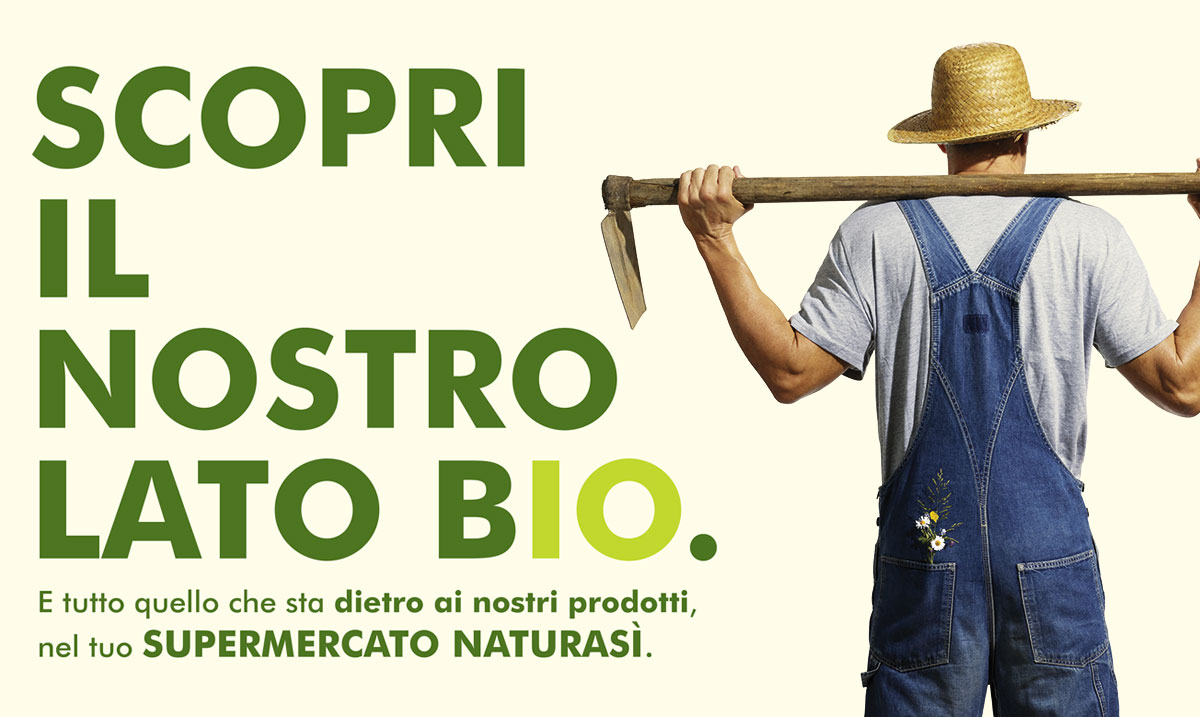
    Recently Natursì has re-planned a campaign carried out in 2017 by the Milanese communication agency Rifattimale by Manfredi Marino and Ugo Berretta. A farmer from behind shows his B (Biodynamic) side and the payoff reads: “DISCOVER OUR B-IO SIDE.” A play on words to attract the attention of consumers and encourage them to adopt a more conscious lifestyle. Roberto Zanoni explains, General Manager of the brand: “Buying food at our supermarkets means recognizing the right price to farmers, facilitating the growth of organic and biodynamic agriculture that protects the land and its fertility. Here, paying a few cents more for the products makes sense. The consumer must understand and be aware of the fact that the purchase choice goes beyond his own portfolio, it is a real responsibility for us and for our children” [iii].

    EcorNaturaSì enjoys an enormous competitive advantage and is now perceived as a leader in the ‘bio’ sector, but it is difficult to think that the attitude of consumers alone will change. To succeed in its purpose, Ecor should involve its competitors in the retail industry and turn them into accomplices by sharing knowledge and experience and guiding the transformation through the more widespread introduction on the market of biodynamic products made available to consumers of all income levels (and not only those who currently attend the Natursì stores). Ecor could incentivize the distribution of biodynamic products, guaranteeing potential growth for all producers thanks to the expansion of the network.

    To accelerate the change, it is the responsibility of companies with a utopian mission (and EcorNaturSì is fully committed) to conduct ‘battles’ at the sector level to create sustainable environmental practices through their own value leadership (and not just the market).

     [i] See, for example, the Adopt a Zolla23 project which invites (as a loan of money) parts of land on biodynamic farms.

    [ii] The promise “The products we distribute must contribute to improving human health, as well as the well-being of the soil and the environment in which we live.”

    [iii] “We want all consumers to be aware and make choices guided by awareness to protect human health, the environment and agriculture” explains Roberto Zanoni , General Manager of the brand. “NaturaSì has been committed for 30 years to supporting organic agriculture and farmers, for human and environmental health: buying food at our supermarkets means recognising the right price to farmers, facilitating the growth of organic agriculture and biodynamics that protect the Earth and it’s fertility. Here, paying a few cents more for the products makes sense. The consumer must understand and must be aware of the fact that the purchase choice goes beyond one’s wallet, it is a real responsibility for us and for our children because if we keep the land alive and fertile, here we can collect food that nourishes us and that does us good over time. This is our bio side: a commitment that we have put in place since the first day and that guides us even more today “.

    Since you’re here…
    Our mission is to monitor Advertising to make certain that companies obey ethical standards of trustworthiness and transparency while communicating their commitment to addressing the great challenges of the New Millennium. From climate emergency to social inequality through all the issues included in the Sustainable Development Goals Agenda, we monitor the consistency of their statements, if they are ‘walking the talk’. With rising misinformation and commercial ownership, independent information is more and more rare. We think citizens deserve access to accurate analyses with integrity at their heart, so we can all make critical decisions about our lives, health and enviroment – based on fact, not fiction.
    Our editorial independence means our content agenda is set only to voice our opinions, supported by in-depth research, free from any political and commercial bias, never influenced by interested owners or shareholders (which we don’t have). It means we can stand up to mainstream and give a voice to those less heard. We hope this will motivate you to make a contribution in support of our open, independent journalism. Every reader contribution, however big or small, is so valuable. Support BeIntelligent from as little as €5 – and it only takes a minute. Thank you.

    Support BeIntellgent

    Author: elena grinta

    I have been dealing with communication for 20 years, I have worked in marketing for large international and Italian companies and I know the mechanisms of advertising persuasion. I decided to invest my know-how and my skills to use the available resources of companies (budgets but also human capital) in positive transformation. Because to students from all over the world I teach at Purpose Brands in Catholic University I wish to give more and more examples of virtuous companies that have invested for the future, of everyone (and there are already many!). Because if we watch, without acting, without taking responsibility, we have no excuse.

  • How to become a brand activist. Tony’s Chocolonley Example

    How to Become a Brand Activist. Follow the Example of Tony’s Chocolonley.

    Creating a movement through a brand is possible only when the people in the company, starting with the CEO, are involved in that cause. 

    I’d love to tell you the story of a well-known journalist who has become a successful entrepreneur with a great purpose. I’m talking about Henk Jan, CEO of Tony’s Chocolonely, who was awarded the title of Marketer of the Year in 2017. Not even Jan himself expected much success from a company born of a journalistic report. It all started in 2003 when, during a documentary for Dutch television, he discovered that most of the cocoa used by the big corporations was collected by exploiting child labor and investigating the main operating brands in the cocoa industry. He soon realized that he had touched one of the points industry pains. This is how the first slave-free chocolate campaign was born. 15,000 indignant consumers pre-ordered the chocolate bars, and the whole supply was sold in a day. After 10 years, the company had a turnover of €9.6 million, and in 2015 it opened its first international office in the United States. To ensure that the chocolate it was buying was slave free, the company entered into an agreement to directly buy cocoa beans from farmers by paying them a figure 25% higher than the average to combat child slavery. From 2017-2018, Tony’s Chocolonely recorded sales of around €55 million.

    Here’s what business with purpose means : the founders started this adventure to meet the goal that the company still has today: freeing the chocolate sector from slavery.

    The company’s motto is “Crazy about Chocolate, Serious about People.” To ensure that it follows through with the motto, Tony’s followed a road map in three steps:

    • Create awareness – since 2005, raise consumers and retailers’ aware of the existing inequalities in the cocoa sector
    • Lead by example – from 2012, try to show the other players of the industry that one can have commercial success without exploiting child labor
    • Inspire to act – today, finding fellow industry, political, NGO, and scientific partners to work together towards change

    So here we are: a true brand activist, born to change the status quo. Jan never gave up his initial mission, which was the engine of his commercial success.

    Not surprisingly, Tony’s is a B Corp [1], a company that voluntarily aims to achieve and maintain certain environmental and social performances and is committed to stakeholders rather than to shareholders.

    For Tony’s Chocolonley, the road is a clear path, and the communication of the results achieved is effective, starting from their trustworthy [2] (several different agencies have verified the company’s claims) and funny sustainability report (yes, I really wrote funny), from which I quote just one of the many choices and results:

    “We could have chosen the path of least resistance. We could have just said, ‘Our chocolate is 100% slave free, pinky promised.’ We could have started our own fully controlled farm. But we did none of the above. Why? Because of ab-so-lute-ly nothing would have changed for the 2.5 million exploited farmers and their families in Ghana and the Ivory Coast. Zip, zilch, nada.”[3]

    No doubt arises, after reading the 69 pages of reports that Tony’s is “an impact organization that sells chocolate and is trying to change the chocolate industry from within.” [4]

    Indeed, one wonders how the big players of the cocoa industry can ignore the appeal of this exceptional company to ‘copy’ their model: “We have not convinced any large company in the industry to copy our game rules. We note that interest is on the rise, but as of 1 October 2018 we have not yet seen any ‘white smoke’ [5].”

    While progress may be slow in the cocoa industry toward equitable and human practices, Tony’s Chocolonely does not stand alone as a B Corp. Other companies––such as Divine Chocolate Ltd in October 2016, Doisy & Dam Limited in April 2017, ÓBOLO Chocolate SpA in April 2019, and Valrhona in January 2020––have also received the certification.

    [1] a certification spread in 71 countries and 150 different sectors, issued to companies by  B Lab , an   international non-profit organization.

    [2] Disclaimer: this is not fake news! We’ve thoroughly checked all the facts and all of them from reliable, independent sources. These include the Global Slavery Index, Tulane University, True Price and the Cocoa Barometer, which monitors the state of affairs in chocolate land every other year. And we’ve also asked PWC to assess the 12 non-financial key performance indicators. Want to know more about the facts? Give us a call or send us an email!

    [3] https://tonyschocolonely.com/storage/configurations/tonyschocolonelycom.us/files/jaarfairslag/2017-2018/tonyjfs_201718_complete_eng.pdf

    [4]The chocolate industry from the inside is an organization that sells chocolate and is trying to change.

    [5] We have not yet persuaded large players in the industry to copy our rules of the game. We can see that there is no white smoke yet, there is a lack of any figures reviewed by PwC.

    Since you’re here…
    Our mission is to monitor Advertising to make certain that companies obey ethical standards of trustworthiness and transparency while communicating their commitment to addressing the great challenges of the New Millennium. From climate emergency to social inequality through all the issues included in the Sustainable Development Goals Agenda, we monitor the consistency of their statements, if they are ‘walking the talk’. With rising misinformation and commercial ownership, independent information is more and more rare. We think citizens deserve access to accurate analyses with integrity at their heart, so we can all make critical decisions about our lives, health and enviroment – based on fact, not fiction.
    Our editorial independence means our content agenda is set only to voice our opinions, supported by in-depth research, free from any political and commercial bias, never influenced by interested owners or shareholders (which we don’t have). It means we can stand up to mainstream and give a voice to those less heard. We hope this will motivate you to make a contribution in support of our open, independent journalism. Every reader contribution, however big or small, is so valuable. Support BeIntelligent from as little as €5 – and it only takes a minute. Thank you.

    Support BeIntellgent

    Author: elena grinta

    I have been dealing with communication for 20 years, I have worked in marketing for large international and Italian companies and I know the mechanisms of advertising persuasion. I decided to invest my know-how and my skills to use the available resources of companies (budgets but also human capital) in positive transformation. Because to students from all over the world I teach at Purpose Brands in Catholic University I wish to give more and more examples of virtuous companies that have invested for the future, of everyone (and there are already many!). Because if we watch, without acting, without taking responsibility, we have no excuse.